A standoff that lasted nearly a year ended yesterday
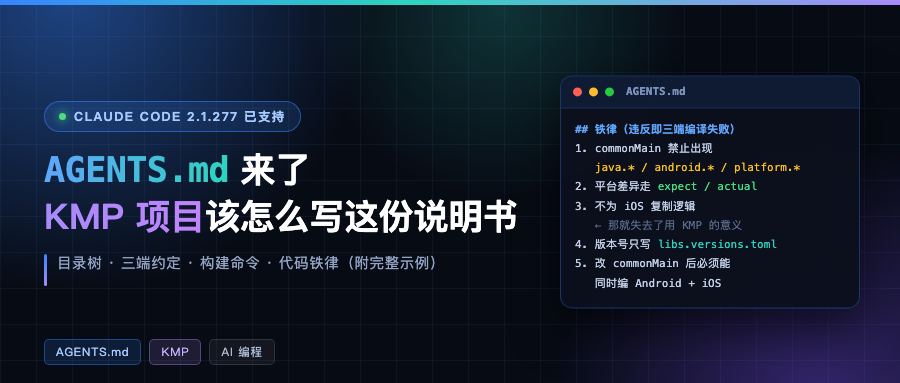
Starting with yesterday’s news: Claude Code 2.1.277 now supports AGENTS.md (September 18).
The Register’s headline was blunt: “Anthropic decides to support OpenAI’s markdown instruction spec.”
If you don’t live inside AI coding tools every day, you might think: it’s a config file name. Who cares?
It matters. Because this whole standoff started with a hard line the Shopify CEO said in public.
Rewind to August 26. Shopify CEO Tobi Lütke posted on X:
I am considering banning Claude Code at Shopify until they are willing to read AGENTS.md, .agents/skills and similar files.
An e-commerce giant threatening to ban a mainstream AI coding tool company-wide — over nothing more than its refusal to read one markdown file.
And the reason he gave is, to me, worth more than the news itself:
Both AGENTS.md and CLAUDE.md apply recursively down the directory tree. When thousands of developers maintain one monorepo, some directory will inevitably be missing a file, and the result is that some developers end up with an agent that has had a chunk of its brain cut out.
We solved it with automation, but that is a stupid complexity tax, and we should not have to pay it at all.
“An agent with a chunk of its brain cut out” — if you have ever maintained a large repo, that one sinks in.
First, what AGENTS.md actually is
The official definition is one sentence:
Think of AGENTS.md as a README for agents.
A README for agents.
A README is for humans: how to get up and running fast, what the project does. AGENTS.md holds what the agent needs but does not belong in a README: build steps, how to run tests, code conventions, a few hard rules.
Its standing today is higher than a lot of people realize:
- Adopted by 60,000+ open source projects
- Started as a collaboration between several: OpenAI Codex, Amp, Google’s Jules, Cursor, Factory
- Now stewarded by the Agentic AI Foundation under the Linux Foundation
The minimal example from the official docs looks like this:
# AGENTS.md
## Setup commands
- Install deps: `pnpm install`
- Start dev server: `pnpm dev`
- Run tests: `pnpm test`

## Code style
- TypeScript strict mode
- Single quotes, no semicolons
That is all it is. No schema, no special syntax. Just markdown.
What makes it actually useful: one file works across multiple agents. Codex, Cursor, Jules, Copilot and Claude Code all read it, so you are not maintaining a config per tool.
Side note: Claude Code insisted on its own
CLAUDE.mdfor a long time. Developers started asking in August 2025, the issue collected nearly 5,000 GitHub reactions, and it was finally closed as won’t fix. It took Shopify threatening a ban to get support on September 18.
Why one file escalates into a platform engineering problem
Plenty of people will think: it is just getting Claude Code to read one more file. Why would Shopify escalate to a company-wide ban?
Because in a monorepo with thousands of people, one file format discrepancy turns into chaos you cannot control.
The mechanism Lütke described is worth copying down:
monorepo/
├── AGENTS.md          ← global rules (tech stack, commit conventions)
├── backend/
│   └── AGENTS.md      ← backend-specific (do not touch db/migrations)
├── mobile/
│   └── AGENTS.md      ← mobile-specific (packaging, signing)
└── infra/
    └── AGENTS.md      ← infrastructure-specific
AGENTS.md applies nearest-first — the agent reads the closest one in the current directory and inherits the rules above it.
That is where the trouble starts:
- Say the team uses both Cursor (reads AGENTS.md) and Claude Code (only reads CLAUDE.md)
- Someone writes
AGENTS.mdundermobile/, and nobody remembers to write aCLAUDE.mdtoo - Developer on Cursor: the agent knows to run the signing script before packaging
- Developer on Claude Code: the agent does not
Same code, same task, two different results. And no alert will ever catch it — you just occasionally notice that a colleague’s AI is “especially dumb.”
That is the complexity tax Lütke was talking about: not that it cannot be solved, but that the problem should not exist in the first place.
Down to practice: writing one for a KMP + AI chat client
Okay, news done. On to the actual subject.
Say we are building a Kotlin Multiplatform + Compose Multiplatform AI chat client — one Kotlin codebase running on Android and iOS.
A project like this has its own quirks when writing AGENTS.md: in one repo, three kinds of code follow completely different rules.
Start with the directory tree:
ai-chat/
├── AGENTS.md                      # root: global hard rules + common commands
├── settings.gradle.kts
├── gradle/
│   └── libs.versions.toml         # version catalog (single source for dependency versions)
├── shared/                        # shared business logic (no UI)
│   ├── AGENTS.md                  # rules for this layer
│   ├── build.gradle.kts
│   └── src/
│       ├── commonMain/kotlin/     # ← shared across platforms
│       ├── androidMain/kotlin/    # ← Android implementation
│       ├── iosMain/kotlin/        # ← iOS implementation
│       └── commonTest/kotlin/
├── composeApp/                    # Compose Multiplatform UI
│   ├── AGENTS.md
│   └── src/
│       ├── commonMain/
│       ├── androidMain/
│       └── iosMain/
├── androidApp/                    # Android shell project
│   ├── AGENTS.md
│   └── src/main/AndroidManifest.xml
└── iosApp/                        # iOS shell project (Xcode)
    ├── AGENTS.md
    └── iosApp.xcodeproj
Note: the structure itself is the first layer of information for the agent. If the agent cannot tell shared/ from composeApp/, it will write UI code into the logic layer.
Root AGENTS.md: only global hard rules and common commands
# AGENTS.md

An AI chat client built with KMP + Compose Multiplatform.
One Kotlin codebase, compiled to Android / iOS.

## Project structure
- `shared/`     — shared business logic, **contains no UI**
- `composeApp/` — Compose Multiplatform UI (all platforms share one set of screens)
- `androidApp/` — Android shell (Activity / Application / manifest)
- `iosApp/`     — iOS shell (Xcode project / SwiftUI entry point)

## Build and test
- Full build:             `./gradlew build`
- Shared module compile:  `./gradlew :shared:compileKotlinMetadata`
- Install to Android:     `./gradlew :androidApp:installDebug`
- Run all tests:          `./gradlew allTests`
- Run one class:          `./gradlew :shared:allTests --tests "*ChatRepository*"`
- iOS framework:          `./gradlew :shared:linkDebugFrameworkIosSimulatorArm64`

## Hard rules (violating these breaks compilation on every target)
1. `java.*`, `android.*`, `platform.*` are **forbidden** in `commonMain`
2. All platform differences go through `expect` / `actual`, never `if (isAndroid)`
3. **Do not copy the logic for iOS** — that throws away the point of using KMP
4. New dependencies go into `gradle/libs.versions.toml` first; modules reference only the alias, **never hardcode a version**
5. After changing `commonMain`, it must still compile for both Android and iOS
A few things about how this is written that I think matter a lot:
① Commands must be copy-pasteable, not descriptions.
Write ./gradlew :shared:compileKotlinMetadata, not “compile the shared module.” Give the agent something it can run directly and it does not have to guess.
② Hard rules need their consequences spelled out.
“No java.* in commonMain” is a rule. Add “it breaks compilation on every target” and the agent understands it is a hard constraint, not a style preference.
③ Kill ambiguity with a single source of truth.
“Versions live only in libs.versions.toml” — that one line stops the agent from hardcoding versions all over the place.
shared/AGENTS.md: only what is specific to this layer
A subdirectory AGENTS.md should not repeat the root file. It should hold only what you need to know once you are in that directory:
# shared/ — shared business logic

## What each source set is for
- `commonMain/` — platform-agnostic logic. Need a platform capability, declare it here with `expect` first
- `androidMain/` — the Android implementation of each `expect` (Android SDK / JVM APIs)
- `iosMain/`     — the iOS implementation of each `expect` (Kotlin/Native + Foundation)
- **Every new `expect` needs both `actual` implementations, in androidMain and iosMain**

## Directory conventions
- `data/`      — repositories, data sources, DTOs
- `domain/`    — domain models, use cases
- `platform/`  — platform abstractions behind expect/actual
                 (KeyValueStore, HttpEngine, AppInfo…)

## Networking (the core of an AI chat app)
- Use **Ktor** everywhere. No OkHttp or URLSession directly in the shared layer
- Streaming responses always return `Flow<ChatChunk>`. Do not manage UI state in shared
- Timeouts, retries and error mapping all live in `data/remote/`

## Commands
- Tests:        `./gradlew :shared:allTests`
- iOS framework: `./gradlew :shared:linkDebugFrameworkIosSimulatorArm64`
See what is in there? This layer holds purely KMP-specific knowledge:
- the pairing rules for
expect/actual(the easiest place to screw up in KMP) - why networking has to be Ktor (OkHttp does not exist on iOS)
- why streaming uses
Flow(the defining feature of an AI chat app)
None of this goes in a general README, and the agent trips on it every single time.
The shell projects: each one says what not to touch
androidApp/AGENTS.md:
# androidApp/ — Android shell

## What goes here
- Activities, Application, AndroidManifest.xml, res/ resources
- **Business logic always goes in shared/, UI always goes in composeApp/**

## Common commands
- Install:  `./gradlew :androidApp:installDebug`
- Logs:     `adb logcat -s AiChat:V`

## Watch out
- New permissions require an AndroidManifest.xml change and **an update to this file**
- Before changing minSdk, check API compatibility for what shared/ uses
iosApp/AGENTS.md:
# iosApp/ — iOS shell (Xcode project)

## Important: this is not built with Gradle
- This is an Xcode project. **Do not try to build it with gradlew**
- After changing code in shared/, run this first:
    `./gradlew :shared:linkDebugFrameworkIosSimulatorArm64`
  so Xcode picks up the new framework, then Run from Xcode

## The Swift side is glue only
- Lifecycle, permission requests, navigation containers
- Business logic **always goes back to shared**. Never rewrite it in Swift

## Common traps
- Missing permission description in Info.plist: only fails at runtime on the simulator, Xcode says nothing
- After changing framework exports, Clean Build Folder
- Kotlin sealed classes must be exhaustively switched on in Swift (write every branch, no default)
Why three separate files?
Because what to do and what not to do flip completely from one directory to the next:
- In
shared/, you write: do not touch platform APIs - In
androidApp/, you write: do not put business logic here - In
iosApp/, you write: do not build this directory with Gradle
One repo, rules that contradict each other. A single root AGENTS.md cannot hold this — that is exactly why nearest-first exists.
Side note: mixed tools on the team
AGENTS.md is only a convention, and different tools still read it differently. The docs give some config pointers:
- Aider: add one line to
.aider.conf.yml—read: AGENTS.md - Gemini CLI: configure
{ "context": { "fileName": "AGENTS.md" } }in.gemini/settings.json - Migrating from the old name:
mv AGENT.md AGENTS.md && ln -s AGENTS.md AGENT.md(the symlink keeps compatibility)
In a KMP project there is also the case of uneven tool versions — someone’s Claude Code is still below 2.1.277. You can drop a CLAUDE.md -> AGENTS.md symlink in the key directories as a stopgap.
But remember what Lütke said: that is paying the complexity tax.
If you can upgrade everyone’s tools, do not maintain two files. Symlinks are a transition, not the destination.
A few traps I have hit
① Do not turn AGENTS.md into a translated README. A README is a project intro for humans. AGENTS.md is an operating manual for the agent. The difference: a README says what, AGENTS.md says how, and it has to be executable.
② Do not write should, recommend, try to. How an agent handles vague wording is unpredictable. Either it is a hard rule (with the consequence stated) or leave it out.
③ Do not let it go stale. A stale command is worse than no command — the agent runs it and gets stuck on a task that no longer exists. When you change a build script, update AGENTS.md in the same pass. Make it a habit.
④ Do not overstuff it. The official minimal example is a dozen lines and it is enough. Context is a budget, and every line you write for the agent takes space away from understanding the code.
⑤ Draw the directory tree.
Best return on effort of anything here. One accurate tree saves the agent ten ls calls.
What I think
First, the AGENTS.md outcome is really platform-neutral beating tool-locked.
Anthropic held out for nearly a year and then supported it anyway. The reason is simple: when 60,000 projects use one format, not supporting it means taxing your users.
That complexity tax line from Shopify hits the real pain every large repo has.
Second, for KMP projects AGENTS.md is probably worth more than for an ordinary project.
Because KMP’s traps are unusually directory-specific:
- Does this code belong in
commonMainoriosMain? Completely different rules - Does this API exist on every platform?
- Do I need to relink the iOS framework after this change?
Saying all of that out loud in every conversation is expensive. Written into directory-level AGENTS.md files, it becomes a one-time investment.
Third, the long-term significance may be bigger than it looks.
As AI coding tools move from completing code to finishing tasks on their own, does the repo have a file that states the rules starts to look a lot like does this project have automated tests — a marker of engineering maturity.
There is a side benefit too: writing AGENTS.md is itself an exercise in cleaning up team conventions. It forces you to write down the implicit rules that only old-timers know — and that may be worth more than making the AI a little smarter.
I would like to ask you:
Does your project have an AGENTS.md? If not, which part do you think is hardest to write: the build commands, or the conventions that live only in people’s heads?
Or what trap have you hit in a KMP project that documentation later fixed? Tell me in the comments and I can turn it into the next post.
Sources: the AGENTS.md spec (agents.md), The Register (9/18), 36Kr / CSDN coverage of the Shopify–Anthropic dispute (8/26), the Claude Code 2.1.277 release notes.