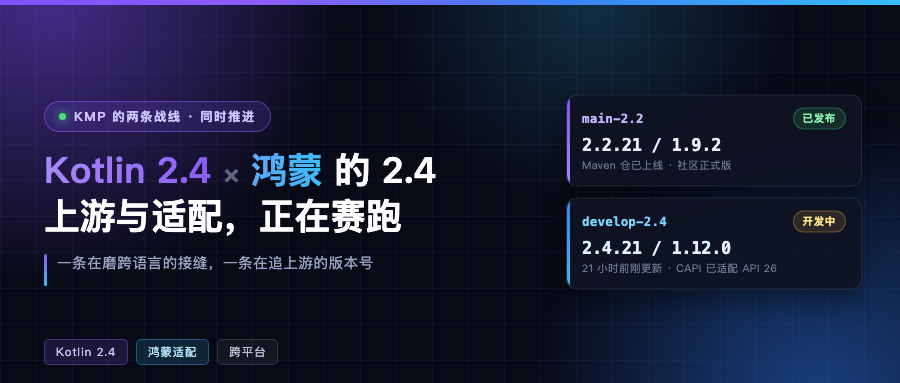
One branch name gives away what is happening
A while back I wrote a piece on HarmonyOS and KMP, and at the time I found one key fact: the stable release the community published was HarmonyOS support built on KMP 2.2.21 / CMP 1.9.2.
Going back to that repo the other day, I found one extra line in the branch list:
develop-2.4 Documentation set for framework KMP 2.4.21 _ CMP 1.12.0
And the branch was updated 21 hours ago.
There is another one:
main-2.2 (default branch) Documentation set for framework KMP 2.2.21 _ CMP 1.9.2
On one side, the stable release already shipped. On the other, the new baseline being pushed forward.
On the HarmonyOS front, KMP is starting to line up with the latest upstream version.
And at almost the same moment, upstream JetBrains had just released Kotlin 2.4.20.
Two tracks, colliding at one point in time.
First, the upstream track: what changed in Kotlin 2.4.20
If you only skim the changelog you might think, oh, another patch-and-polish release — of the two hundred-odd changes, most are bugfixes.
But a few of them land hard for people who write KMP.
One: Swift interop can finally hold its own.
Swift export now supports mapping Kotlin’s sealed class straight to a Swift enum:
// no more default
let name = switch shape.sealedType() {
case .circle(let t):    "圆"
case .rectangle(let t): "方"
}   // ← exhaustiveness check
Handling this kind of polymorphic type used to mean either a pile of if let on the Swift side, or being forced to add a default branch that can never run — which kills exhaustiveness checking outright. Now the compiler catches the gaps for you.
There is also cross-language inheritance: a Kotlin type can inherit from a Swift class or protocol (including pure Swift libraries), with no wrapper layer needed.
Both point the same direction: the interop friction KMP has always been criticized for on iOS is being sanded down, bit by bit.
Two: klib incremental compilation hits Beta.
kotlin.incremental.native=true
Change one line of Kotlin and you no longer wait for the whole native module to rebuild. If you have done Kotlin/Native, you know what that does for the day-to-day.
Three: the Kotlin/JS test toolchain moved from Karma to Playwright — about time.
So the theme of the upstream track is: smoothing out the seams between languages.
Now the HarmonyOS track: where it actually stands
To understand the HarmonyOS side you have to start with its version numbering scheme, written in the stable release announcement that went out yesterday:
Version numbers use “upstream baseline + HarmonyOS adaptation sequence”: 2.2.21-1.0.0 / 1.9.2-1.0.0 means a HarmonyOS adaptation stable release based on upstream KMP 2.2.21 and CMP 1.9.2.
That rule matters. It says one thing:
HarmonyOS support is not a separate stove. It is chasing upstream versions.
Which is why you see numbers like 2.2.21-1.0.0 — the 2.2.21 in front is the upstream Kotlin version it corresponds to, and the 1.0.0 behind is the HarmonyOS adaptation’s own iteration number.
Already published to Maven:
| Component | Version | Status |
|---|---|---|
| kotlin | 2.2.21-1.0.0 | Published to Maven |
| compose-multiplatform | 1.9.2-1.0.0 | Published to Maven |
| compose-multiplatform-core | 1.9.2-1.0.0 | Published to Maven |
| skiko | 0.9.22.2-1.0.0 | Published to Maven |
| akinterop | 1.0.1 | Published to Maven |
| KMP OHOS Support | 1.0.0 | Published to the plugin marketplace |
And the new develop-2.4 branch targets a baseline of KMP 2.4.21 / CMP 1.12.0.
The development cadence announcement says it too:
develop branch: used for monthly development-state code merges, merged into main after each monthly release gate.
In plain language: one version forward every month, merged into the stable line only once it is ready. Not shipping on a whim, but a rolling cadence.
What that branch has been busy with
I went through the develop-2.4 commit history. The recent activity is interesting.
The latest one adapts the CAPI user manual to API 26 — bumping the OHOS CAPI version to API26, updating “modules, minimum API, and typical dependency libraries” to match, and adding a whole section on “special changes caused by the CAPI upgrade to API 26.”
Another one updates akinterop to 1.0.1 and sqldelight to 2.2.1-1.1.0.
Those two directions map exactly to the two real blockers for HarmonyOS cross-platform work:
- CAPI follows the HarmonyOS system version — the system upgrades, the bridge layer has to upgrade with it. That is the “do not fall behind” problem
- Adapted version numbers for third-party libraries — whether the ecosystem libraries keep up decides whether a project dares to use this at all
While we are here: what CMP 1.12 brings upstream
Since develop-2.4 is tracking CMP 1.12.0, what changed in 1.12 upstream is worth a look too.
CMP 1.12.0 shipped on August 25, and the highlight is on the Desktop side:
MCP server was introduced for Compose Hot Reload that enables AI agents to interact with a running Compose application in real time
In plain language: Compose hot reload got an MCP server, so an AI agent can interact with a running Compose app in real time.
That one is subtle. The intersection of Compose and AI is moving from “use AI to write Compose code” toward “let AI operate the running app directly.”
It also brings a batch of breaking changes, so watch out when migrating:
- The deprecation level on typealiases like
NativeCanvasandNativePaintwas raised to ERROR - The
backgroundparameter onSwingPanelis deprecated
Jumping from 1.9.2 to 1.12.0 is not just a version number change — migration cost counts too.
What the two things together tell you
Put the two tracks side by side and the picture is fairly clear:
KMP’s “one codebase, many platforms” is being pushed forward on several fronts at once.
- Upstream is polishing cross-language interop (Swift export, incremental compilation)
- The HarmonyOS community track is chasing upstream versions (2.2 → 2.4), filling in system support (CAPI → API 26), and widening the third-party library ecosystem
They are not the same team, but they are heading in the same direction — making “write Kotlin once, run on more platforms” a little less friction.
For developers, the test is simple:
When you evaluate a new platform, the question is no longer “does it support this” but “which upstream version has it caught up to, are the libraries enough, does the performance hold up.”
From “can it run” to “can it keep up” — that shift is itself a new stage.
But the community’s real voice is worth more than the announcement
Announcements are always pretty. I went and read the community discussion forum on purpose, because that is where this track’s actual temperature is.
The hottest thread asks “can this be merged into the official JetBrains branch soon” (started 30 days ago, 7 replies).
The poster was direct:
Adding HarmonyOS to my existing pure KMP & CMP app project runs into a large number of unsupported libraries, and during compilation several already-adapted libraries show internal dependency conflicts. I hope it can be merged upstream soon so library developers across the whole KMP community can add ohos versions, the CPF community’s progress on library support is far too slow.
He named three libraries specifically: androidx-datastore, androidx-room3, androidx-sqlite — “these three are basically the foundational dependency libraries for the persistence approaches everyone uses.”
Then the part that stings:
None of them support ohos x86. On Windows a developer can barely build and test an app with normal functionality — at minimum you have to keep a HarmonyOS phone plugged in as the test target…
He also gave a concrete trap: a room3 alpha pulled from some mirror repo generates code that errors on a missing androidx.sqlite implementation, while upstream room3 3.0.1 works fine.
The official reply came, and it was honest:
Hello, support for ohos x86 is already in planning, thanks for your interest.
Other threads are each real in their own way:
- “Under skia rendering the page frame production is dragged to about one frame per 3 seconds, suspected abnormality in the VsyncOnDemand deferred deregistration mechanism” — performance
- “material3 blocks porting an existing project” — component library traps
- “Is webView supported right now?” — capability coverage
- “Has anyone actually shipped a project? What traps did you hit” — and someone replied with: “currently doing a KMP adaptation of a voice assistant”
Add these up and you have the real state of this track: it runs, people are using it, but the ecosystem and performance are still catching up.
Why “following upstream” is slow work
Seeing that “progress is far too slow” line, some people will assume it is a matter of insufficient investment.
But there is a technical reality worth spelling out: HarmonyOS support changes the compiler backend. It is not writing a plugin.
Go through the CPF-KMP-CMP repo list and you see these names:
kotlin, compose-multiplatform, compose-multiplatform-core, skiko, akinterop, cicd-toolkit…
These are HarmonyOS forks of the Kotlin compiler, the Compose framework, and the graphics rendering layer.
Which means the work includes at least:
- Adding a new compilation target to Kotlin/Native
- Wiring Compose’s rendering pipeline into HarmonyOS’s Render Service
- Getting the Skia graphics library that Skiko wraps to run on HarmonyOS
And every time upstream ships a new version, all of those changes have to be re-aligned.
That is what the “upstream baseline + adaptation sequence” version scheme really means — it describes the nature of the work precisely: continuous tracking, not a one-time port.
Look again at “monthly development-state merges, merged into main after each monthly release gate” and it reads differently:
This is not slow. This is doing a very heavy thing at a pace that can be sustained.
A few of my own views
One: the essence of “adaptation” here is following upstream, not reinventing the wheel.
You can see it in the version scheme alone (upstream baseline + adaptation sequence). The core work on the HarmonyOS track is getting upstream’s compiler and UI framework running on HarmonyOS, not inventing a separate API.
Which means its ceiling is tied to upstream: upstream smooths out Swift interop and that is a dividend for iOS; upstream improves the compiler and HarmonyOS only gets it by keeping up.
Two: the three community complaints point at the same problem.
x86 support, third-party library versions, performance — three things on the surface, all “ecosystem maturity” underneath.
And ecosystem maturity has a cruel property: it cannot be solved with enthusiasm, only with time and real projects wearing it in. The official reply of “already in planning” is true, and there is a certain helplessness in how true it is.
Three: if you are evaluating whether to get on this track, here is a framework.
Do not ask “does it support HarmonyOS” — ask these three questions:
- Which upstream version has it caught up to? (right now 2.2.21 is stable, 2.4.21 is in development)
- Have the libraries I depend on been adapted? (especially foundational ones like persistence and networking —
room3anddatastoreare the acknowledged pain points) - What is my dev machine? (if you need an x86 emulator, you still have to wait; an Apple silicon Mac plus a real device is the steadier combination)
All three clear, then start. One blocked, and the plan goes in a note for later.
Last
Kotlin 2.4 and HarmonyOS 2.4 look like two unrelated things.
But they are answering the same question:
One body of Kotlin code: how many places can it run, and how well?
Upstream is sanding down the seams between languages, and the HarmonyOS track is widening the map.
Both are making that number bigger.
I want to ask you something:
Would “HarmonyOS support has caught up to 2.4” make you reconsider a KMP project you have on your desk?
Or have you already been through the traps on this track? Talk in the comments — I would genuinely like to hear from real projects.
References: CPF-KMP-CMP community repos (AtomGit/GitCode) branch and release announcements, public posts in the community discussion forum, JetBrains Kotlin 2.4.20 release notes.